Visualizzazione post con etichetta photos. Mostra tutti i post

10 gennaio 2013

InNOvative paintbrushes.


Paintbrush as all artificats always develops its form, becomes adapted to more specialized problems (corners, paint kinds etc.). But sometimes, as says Henry Petroski, among his different debations, in his book 'The evolution of useful things', form doesn't follows function, but starts to follow fashion. Reffering to words of Viollet-le-Duc who comparing vase and it's evolution, shows 'how the form can change first for the better and then for the worse', what fashion makes with present objects. 
 Nowadays the painbrushes rather keep its'  form since centeries and eventually change materials for more demanding liquids like solvents, varnishes etc.  However form of art paintbrushes don't change much, don't get useless decorations or deformations, what could be consider as a kind of love for this traditional tool, used, as it is now, by famous painters. 


7 gennaio 2013

Paintbrush of death.


Martial art 'baguazhang' uses techniqe called 'paintbrushes of death' which name comes from ancient China where they used a specific paintbrush firming death sentences.


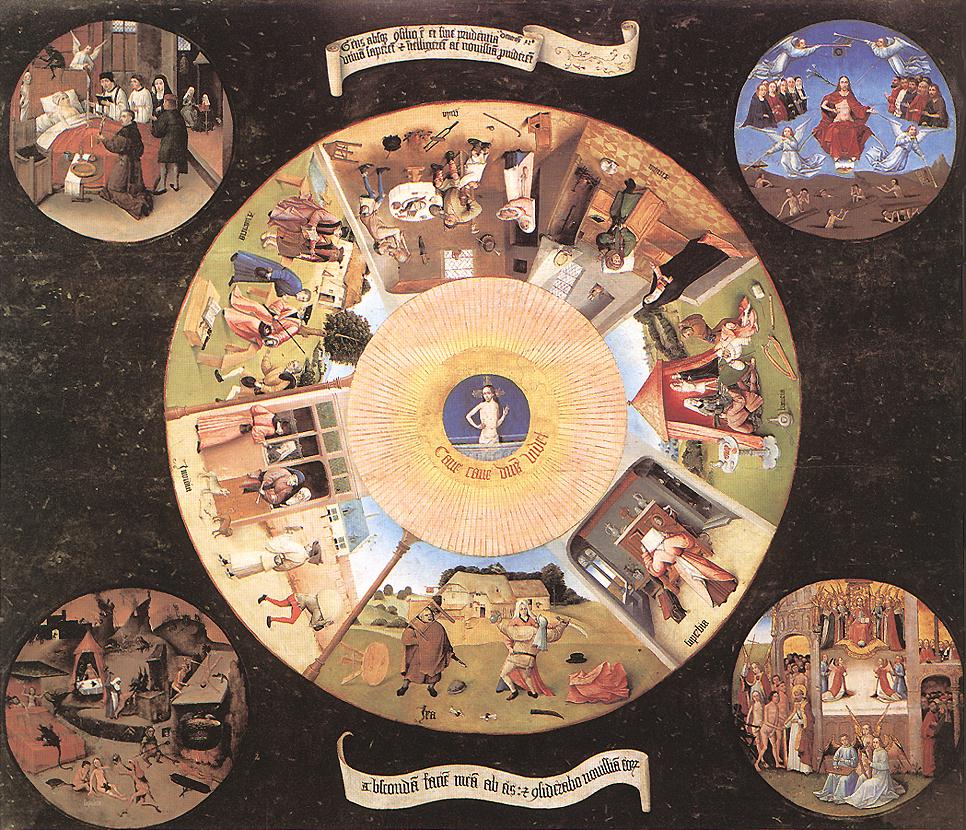
Deadly sins

Paintbrush in deadly sins:

luxuria - wish of being the best artist, having the best talent, to get a lot of money for works

gula -  its function in kitchen as a tool to cover pastry by egg etc.

acedia - a paintbrush could be rather a symbolic opposite, considering  all his properties. It's always present kind of activity, creativity etc.

ira - paintbrush as a tool causing artistic battle between talented artists (for example between Modgliani and Picasso)

invidia - jealousy of being worse painter and lower positing by itself

superbia - pride of having talent that noone else can raise. As the simple example I'd point on Dali, who never doubted his genius in front of mortals

(avaritia)


Seven deadly sins - Hieronim Bosch


31 ottobre 2012

Anatomy of a Paint Brush

ANATOMY

A paint brush is made of three parts:
  • Head- hairs or bristles of the brush. The head is composed of three parts: the toes (the tip of the hairs), the belly (the fattest, central part of the head), the heel (part next to ferrule).
  • Ferrule- the metal cylinder that combine the head and the handle. High quality ferrules are seamless and non-corrosive; can be made of aluminium, nickel, copper or nickel-plated steel.
  • Handle- the longest section of the brush, where the brush is held. Usually made of wood or plastic. 


SIZE

Brushes are produced in a wide variety of sizes, from huge wash brushes to extra-tiny ones. The size is printed on their handles. 
The sizes starts from 0 (or its multiples : 00, 000, 000 or 2/0, 3/0 etc. ) and ranges up to as high as 30.

The brushes can be short or long handled.
 The wood is sealed and lacquered to give the handle a high-gloss, waterproof finish that reduces soiling and swelling. 
Short handled ones are more often use in water coolor or ink painting, the long handled ones for oil or acrylic painting.


SHAPE

BRISTLE


Brushes can be made of synthetic or natural bristle, which have different properties:

Natural hair- has an outer casing known as a cuticle, which let them absorb moisture, so this way they are able to hold more color; are also wear resistant and work well with any medium.
They can be made of kolinsky sable, ox, hog, squirrel, pony, goat, mongoose or badger hair. 

Synthetic hair- are less prone to be damaged by solvents, insects and harsh paint. They lack moisture absorbing properties so the are easier to clean. Synthetic bristle is more durable and also is more resitant fot caustic effects of acrylic paints.
They can be made of nylon filament, taklon, multi-diameter polyester.